Biophilic Design in Real Estate: Evidence and ROI
2026-03-26 · 13 min read · David Serrano
What Is Biophilic Design?
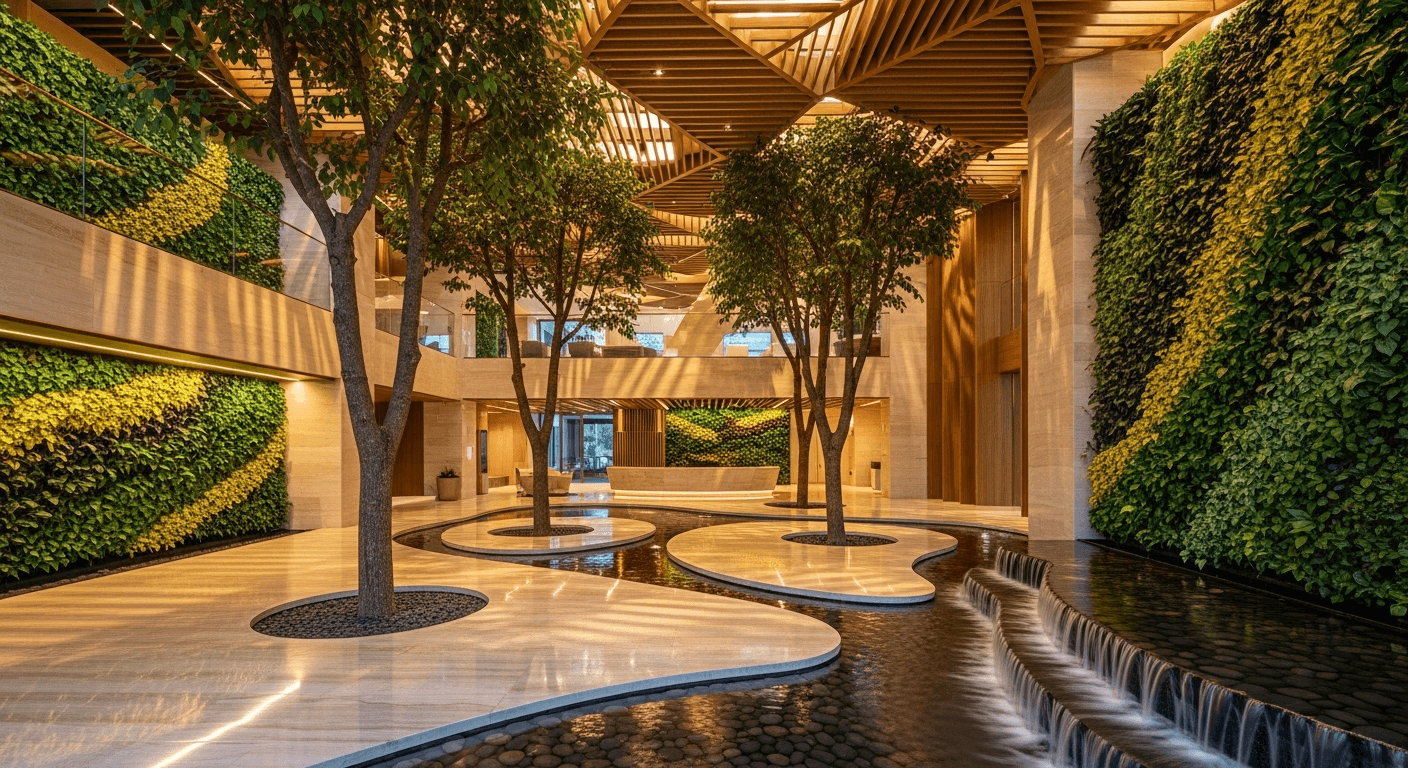
Biophilic design is the evidence-based practice of incorporating natural elements, patterns, and spatial experiences into the built environment to improve occupant health, cognitive function, and emotional well-being. Rooted in E.O. Wilson's biophilia hypothesis (1984) — that humans possess an innate biological affinity for natural systems — biophilic design translates evolutionary neuroscience into architectural strategy.
Biophilic design is not interior decoration with plants. It is a systematic framework encompassing three categories of design intervention: direct nature (living plants, water features, natural light, airflow), indirect nature (natural materials, organic forms, biomimetic patterns, complexity and order), and spatial conditions (prospect and refuge, mystery and discovery, compression and expansion). When all three categories are integrated into a building's architecture — not just its furnishing — the measurable impacts on occupant well-being and property value are substantial.
For real estate developers, biophilic design represents a transition from amenity-driven differentiation (gym, pool, rooftop) to experience-driven differentiation — buildings that make occupants feel measurably better, and that command premiums because of it.
The Neuroscience of Biophilic Design
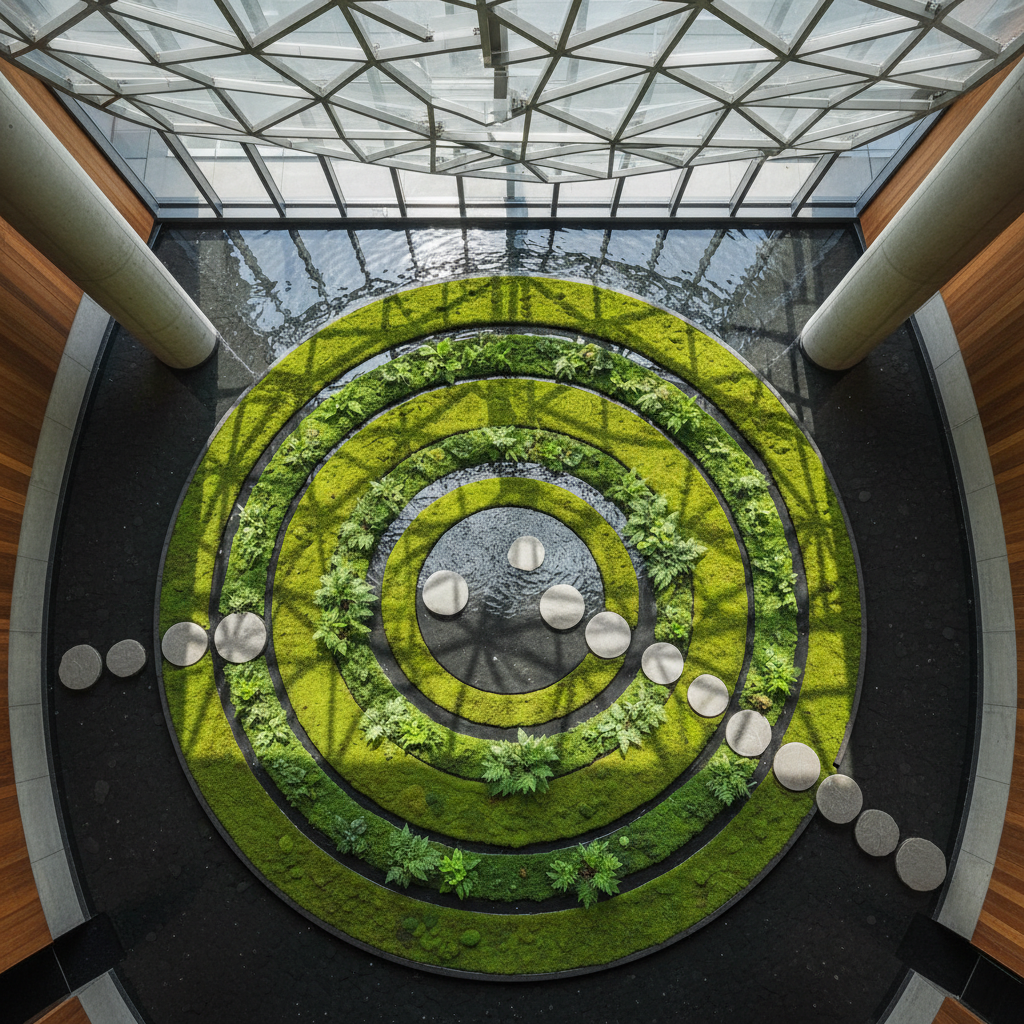
The case for biophilic design is not aesthetic — it is neurological. A growing body of peer-reviewed research demonstrates measurable physiological and cognitive responses to biophilic environments.
Stress Reduction: The Cortisol Evidence
Research published in the International Journal of Environmental Research and Public Health shows that exposure to biophilic environments — spaces with natural materials, organic geometry, and living elements — reduces salivary cortisol (the primary stress hormone) by up to 60% within 20 minutes of exposure. This is not subjective preference. It is a measurable hormonal response that occurs consistently across demographic groups and cultural contexts.
Fractal Complexity: The D=1.3-1.5 Range
Physicist Richard Taylor (University of Oregon) and architectural theorist Nikos Salingaros have demonstrated that visual environments with fractal dimensions between D=1.3 and D=1.5 produce the greatest stress-reducing and attention-restoring effects. This range corresponds to the fractal complexity found in natural phenomena — tree canopies, cloud formations, river networks, mountain ridgelines. Flat, featureless surfaces (D approaching 1.0) and chaotic, overly complex environments (D approaching 2.0) both produce measurably negative neurological responses: elevated cortisol, reduced attention, and reported discomfort.
This finding has direct architectural implications. Parametric facades and ceilings naturally produce fractal complexity in the D=1.3-1.5 range because algorithmic variation from environmental data creates the kind of structured complexity that characterizes natural systems. A parametric wood ceiling with varied perforation patterns, a facade with algorithmically graduated panel angles — these elements are not mimicking nature. They are producing the same mathematical properties that make natural environments neurologically restorative.
Cognitive Performance
The Human Spaces Report (2015, commissioned by Interface) surveyed 7,600 office workers across 16 countries and found that employees in biophilic workplaces reported 15% higher well-being, 6% higher productivity, and 15% higher creativity compared to those in environments devoid of natural elements. Subsequent laboratory studies at Harvard and the University of Exeter have confirmed these findings with controlled experiments, demonstrating that views of nature, natural materials, and organic spatial configurations improve attention, memory, and creative problem-solving.
Recovery and Healing
Roger Ulrich's foundational research (1984, Science) demonstrated that hospital patients with views of trees recovered 8.5% faster, required fewer analgesic doses, and had fewer negative evaluations from nursing staff compared to patients with views of a brick wall. This research has been replicated and extended across healthcare, educational, and workplace settings. The implication for real estate: biophilic design is not a luxury feature. It is a functional performance intervention with measurable outcomes.
Biophilic Design in Real Estate: Premiums and Absorption
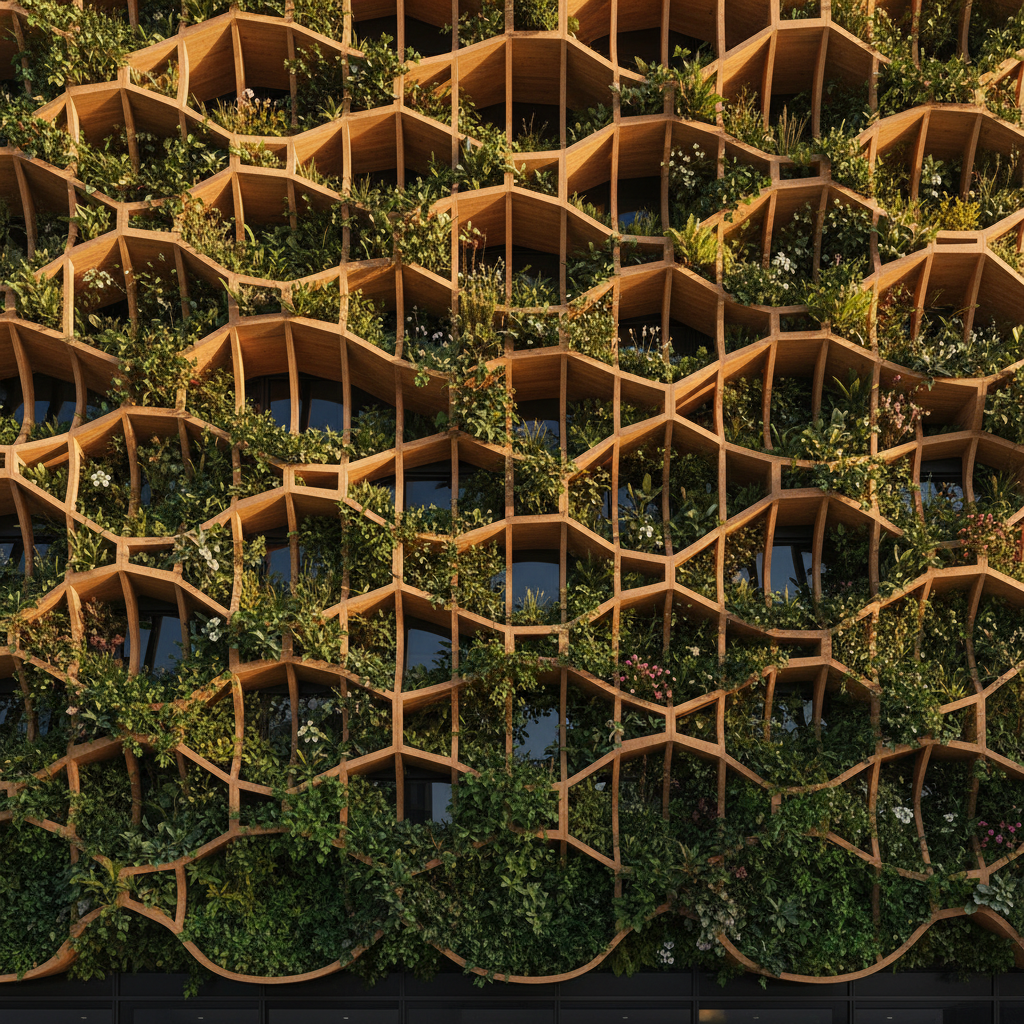
The neurological evidence translates directly into real estate economics. Biophilic buildings outperform conventional buildings on every metric that matters to developers.
Price Premiums
Terrapin Bright Green's research (2012, 2018) and subsequent market analyses demonstrate that biophilic design elements contribute to 10-20% sale price premiums in residential markets. When combined with wellness certification (WELL) and parametric facade differentiation, the total premium can reach 25-35% above conventional competition — the additive effect of biophilic experience, certified wellness, and architectural distinction.
In commercial real estate, biophilic office environments achieve $5-12/sf rent premiums (CBRE, Cushman & Wakefield data). Tenants — particularly tech companies, creative agencies, and professional services firms — actively seek biophilic spaces as recruitment and retention tools. In a tight labor market, the building itself becomes part of the employer's value proposition.
Absorption and Retention
Biophilic residential developments report 15-25% faster absorption rates compared to conventional projects in the same market. The explanation is straightforward: biophilic design creates emotional connection during the showroom visit. Buyers do not just evaluate floor plans and finishes — they respond physiologically to the space. Natural light, organic materials, fractal visual complexity, and views of greenery trigger the same neurological responses that the research documents. The buyer feels better in the space, and that feeling accelerates the purchase decision.
For commercial assets, tenant retention in biophilic buildings runs 8-15% higher than market average. Tenants report higher employee satisfaction, which translates into lease renewal decisions. Lower turnover means lower leasing costs and more stable income — directly improving asset value.
Market Positioning
In saturated luxury markets — Dubai, Miami, Singapore, Mexico City — amenity lists have converged. Every premium development has a gym, a pool, a rooftop terrace. Biophilic design offers a differentiation strategy that is experiential rather than programmatic. The building does not just have more amenities; it feels fundamentally different. That experiential differentiation is harder for competitors to replicate than adding a co-working lounge.
Parametric Design as the Delivery Mechanism for Biophilic Architecture
Here is the critical connection that most biophilic design literature misses: parametric design is the most effective tool for implementing biophilic principles at building scale.
Biophilic design strategies — fractal complexity, organic geometry, varied light patterns, natural material expression — require architectural elements that vary continuously across surfaces, respond to environmental conditions, and create the kind of structured complexity found in natural systems. These are precisely the characteristics that parametric design produces.
Fractal Facades
Parametric algorithms driven by solar radiation data naturally produce facade patterns with fractal dimensions in the neurologically optimal D=1.3-1.5 range. Panel angles that vary in response to cumulative solar gain create the same graduated complexity seen in tree bark, leaf venation, or rock formations. The biophilic quality is not imposed — it emerges from performance optimization.
Dynamic Light Patterns
Parametric facades with algorithmically varied apertures create changing light and shadow patterns across interior spaces throughout the day. This replicates one of the most powerful biophilic conditions: dappled light — the shifting light-and-shadow play that occurs under tree canopies. Research by Terrapin Bright Green identifies dynamic light as one of the 14 Patterns of Biophilic Design, and rates it as a high-impact, low-cost intervention when achieved through architectural geometry rather than mechanical systems.
Organic Spatial Sequences
Parametric design enables the creation of continuously varying spatial experiences — ceiling heights that rise and fall, corridor widths that compress and expand, sightlines that reveal and conceal. These spatial sequences replicate the prospect-refuge and mystery patterns identified in biophilic design research as primary drivers of spatial preference and emotional comfort. Conventional design can attempt these effects, but parametric design calibrates them precisely based on neuroscience data.
Biomimetic Structure
Parametric structural optimization often produces geometries that closely resemble biological structures — branching columns, lattice shells, voronoi tessellations — because biological structures have already evolved to solve the same optimization problems (maximize strength, minimize material, distribute loads efficiently). When parametric algorithms optimize a structural system, the result frequently looks biophilic because nature and the algorithm are solving the same equation.
"Biophilic design tells us what humans need from architecture. Parametric design tells us how to deliver it precisely, at scale, and with measurable performance data. The two disciplines are complementary — biophilic principles set the targets, and parametric algorithms achieve them," says David Serrano, Founder of Arquitectura Introspectiva.
Implementation for Developers: A Practical Biophilic Design Framework
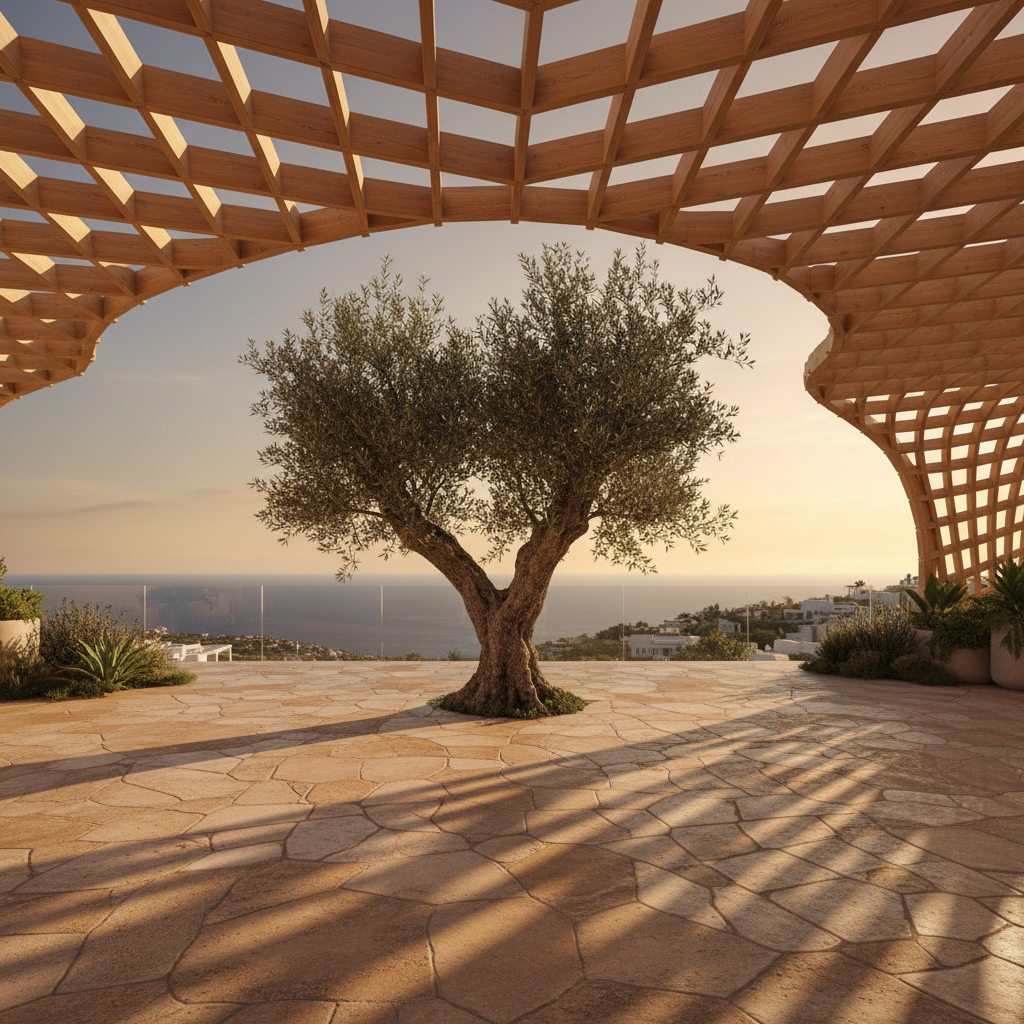
Biophilic design implementation follows a structured approach. For developers, the key is to identify which biophilic strategies deliver the highest return for the specific project type and market.
Tier 1: High Impact, Integrated Into Architecture (Design Phase)
- Parametric solar shading with fractal complexity: Facade geometry that delivers both solar performance and biophilic visual complexity. Cost: included in parametric facade budget. Impact: 8-17% sale premium + 25-45% cooling reduction.
- Maximized daylight with controlled variability: Parametric aperture design that creates dynamic, dappled light conditions. Cost: included in envelope design. Impact: sDA > 55%, occupant satisfaction + wellness certification credits.
- Natural material expression: Timber, stone, and planted surfaces in primary spatial experiences (lobbies, corridors, amenity spaces). Cost: 5-15% above synthetic alternatives. Impact: cortisol reduction, perceived quality, premium positioning.
- Prospect-refuge spatial sequences: Ceiling height variation, compression-expansion sequences, framed views of nature. Cost: minimal when integrated from schematic design. Impact: enhanced spatial experience, stronger emotional response during sales.
Tier 2: Medium Impact, Systems and Landscape
- Living walls and interior planting: Vertical gardens in common areas, lobby planting, terrace greenery. Cost: $150-500/m² for living wall systems + $20-50/m²/year maintenance. Impact: air quality improvement, visual biophilia, marketing differentiation.
- Water features: Moving water in lobbies, courtyards, or arrival sequences. Cost: $50,000-300,000 depending on scale. Impact: acoustic masking, thermal cooling perception, strong biophilic response (water is a primary biophilic element).
- Acoustic design with natural sound: Sound masking using natural recordings (water, bird calls) or acoustic materials that reduce reverberation to biophilically preferred levels (RT60 < 0.6s in residential, < 0.8s in office). Cost: $5-15/m². Impact: reduced stress, improved cognitive performance.
Tier 3: Landscape and Community Scale
- Visible nature: Ensure 70%+ of occupied spaces have views to vegetation, sky, or water. Site planning and massing decisions that prioritize nature visibility. Cost: design phase decision, not construction premium. Impact: foundational biophilic benefit, Ulrich's research applies directly.
- Outdoor biophilic spaces: Parametrically designed gardens, courtyards, and terraces with shade structures, native planting, and varied microclimates. Cost: $100-400/m² depending on complexity. Impact: extended living space, community building, marketing asset.
ROI Framework: The Financial Case for Biophilic Design in Real Estate
For developers building a pro forma, here is how biophilic design impacts the numbers.
Investment
Comprehensive biophilic design integration typically adds 2-7% to total construction cost, depending on the depth of implementation. Tier 1 strategies (parametric facades, daylight optimization, natural materials, spatial sequences) add 2-4%. Adding Tier 2 (living walls, water features, acoustic design) adds another 2-3%. The investment is front-loaded in design and construction but generates returns throughout the asset's lifecycle.
Revenue Impact
- Residential sale price premium: 10-20% for biophilic design alone; 25-35% when combined with parametric facade differentiation and WELL certification
- Commercial rent premium: $5-12/sf for biophilic environments, additive with WELL certification premiums ($10-15/sf)
- Absorption acceleration: 15-25% faster residential sales; 20-30% faster commercial lease-up
- Retention improvement: 8-15% higher tenant retention in commercial, reducing turnover and leasing costs
Operating Impact
- Energy reduction: Biophilic strategies (daylight optimization, natural ventilation, passive cooling through shading) reduce energy costs by 15-25% when integrated with parametric envelope design
- Productivity gains (commercial): 6-15% productivity improvement translates to $2,000-5,000/employee/year in value — a compelling argument for corporate tenants evaluating total cost of occupancy
- Health cost reduction: 30% fewer sick building syndrome symptoms translate to reduced absenteeism — estimated at $1,200-1,800/employee/year in avoided productivity loss
Sample Pro Forma Impact
For a 150-unit premium residential tower ($5,000/m² baseline, 12,000 m² sellable area):
- Baseline GDV: $60,000,000
- Biophilic + parametric premium (20%): +$12,000,000
- Construction premium (5% on $45M build cost): +$2,250,000
- Net value creation: $9,750,000
- Return on biophilic investment: 4.3x
- Absorption acceleration (20% faster): 3-4 months earlier stabilization, reducing carrying costs by $300,000-500,000
"Biophilic design is the most underleveraged value creation strategy in real estate development. The neuroscience is clear, the market data is consistent, and the cost is modest relative to the return. Developers who integrate biophilic principles through parametric design create assets that are neurologically optimized for human well-being — and the market prices that difference," says David Serrano.
Related: What Is Parametric Architecture? → | ¿Qué es la Neuroarquitectura? → | Wellness Architecture ROI → | Parametric Facades & Cooling Costs →
FAQ
What is biophilic design?
Biophilic design is the evidence-based practice of incorporating natural elements, patterns, and spatial experiences into the built environment to improve occupant health, cognitive function, and emotional well-being. It encompasses three categories: direct nature (plants, water, natural light), indirect nature (natural materials, organic forms, fractal complexity), and spatial conditions (prospect-refuge, compression-expansion, mystery). When integrated into architecture — not just interior decoration — biophilic design produces measurable physiological responses: up to 60% cortisol reduction, 15% higher productivity, and 6% higher creativity.
How does biophilic design affect property value?
Biophilic design delivers 10-20% sale price premiums in residential markets and $5-12/sf rent premiums in commercial markets (Terrapin Bright Green, CBRE data). When combined with parametric facade differentiation and WELL certification, total premiums can reach 25-35% above conventional competition. Biophilic buildings also absorb 15-25% faster in residential and achieve 8-15% higher tenant retention in commercial — both directly improving developer returns through reduced carrying costs and more stable income.
What is the neuroscience behind biophilic design?
Biophilic environments reduce salivary cortisol (stress hormone) by up to 60% within 20 minutes of exposure. Visual environments with fractal dimensions of D=1.3-1.5 — the range found in natural phenomena like tree canopies and cloud formations — produce the greatest stress-reducing and attention-restoring effects (Taylor, Salingaros research). The Harvard COGfx study showed 101% higher cognitive function in high-performance buildings with biophilic elements. Roger Ulrich's foundational research demonstrated 8.5% faster hospital recovery with nature views.
How does parametric design enable biophilic architecture?
Parametric design is the most effective delivery mechanism for biophilic principles at building scale. Parametric algorithms driven by environmental data naturally produce fractal complexity in the neurologically optimal D=1.3-1.5 range. Parametric facades create dynamic dappled light patterns — a primary biophilic condition. Parametric spatial design calibrates prospect-refuge and compression-expansion sequences based on neuroscience data. And parametric structural optimization often produces biomimetic geometries because nature and algorithms solve the same optimization problems. Biophilic principles set the targets; parametric algorithms achieve them.
How much does biophilic design cost to implement?
Comprehensive biophilic design adds 2-7% to total construction cost. Tier 1 strategies (parametric facades with fractal complexity, daylight optimization, natural materials, spatial sequences) add 2-4% and deliver the highest ROI. Tier 2 (living walls at $150-500/m², water features at $50K-300K, acoustic design at $5-15/m²) adds 2-3%. The investment returns 10-20% in sale price premiums and 15-25% faster absorption — a 3-5x return on the incremental cost. Many Tier 1 strategies cost nothing extra when integrated from schematic design.